The implicit-bias program
Why does training a model without an explicit regularizer, with the loss driven nearly to zero, still produce a solution that generalizes? The classical answer is that the objective has to carry the regularizer somewhere. The implicit-bias answer is more subtle: even when the objective has many minima, gradient descent does not choose among them neutrally; the algorithm itself selects a particular kind of solution.
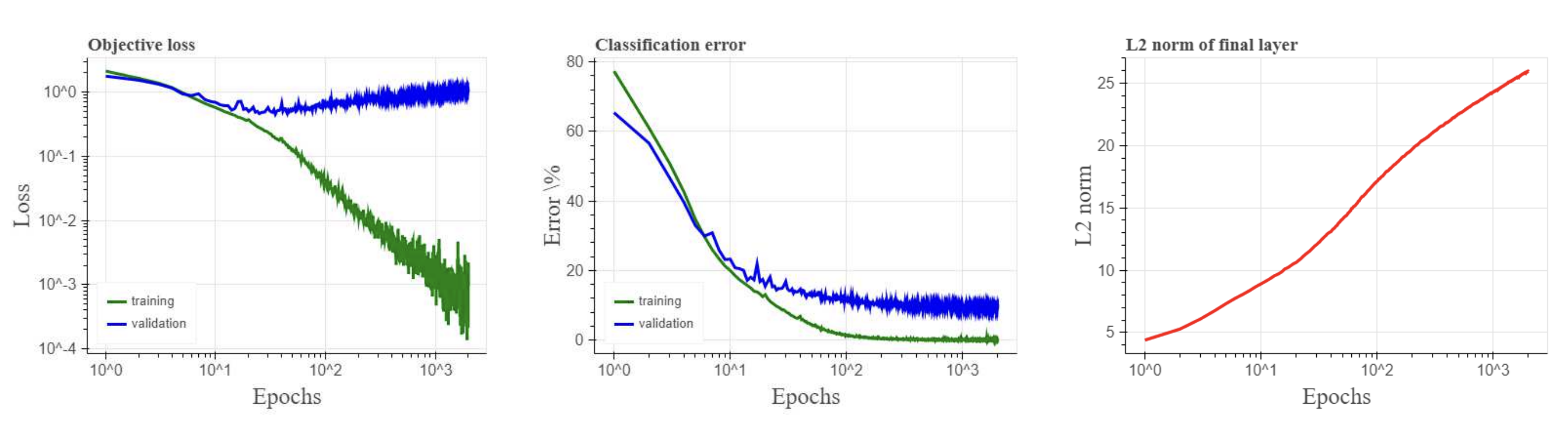
Zhang et al. [2] sharpened the puzzle that most of this literature now opens with. Standard image classifiers fit random labels as easily as they fit true ones, which kills the simplest capacity-based explanation of generalization: the hypothesis class is large enough to memorize anything. Whatever is producing the generalization, then, must come from the optimizer, the data, or the parameterization, not from the loss function itself.
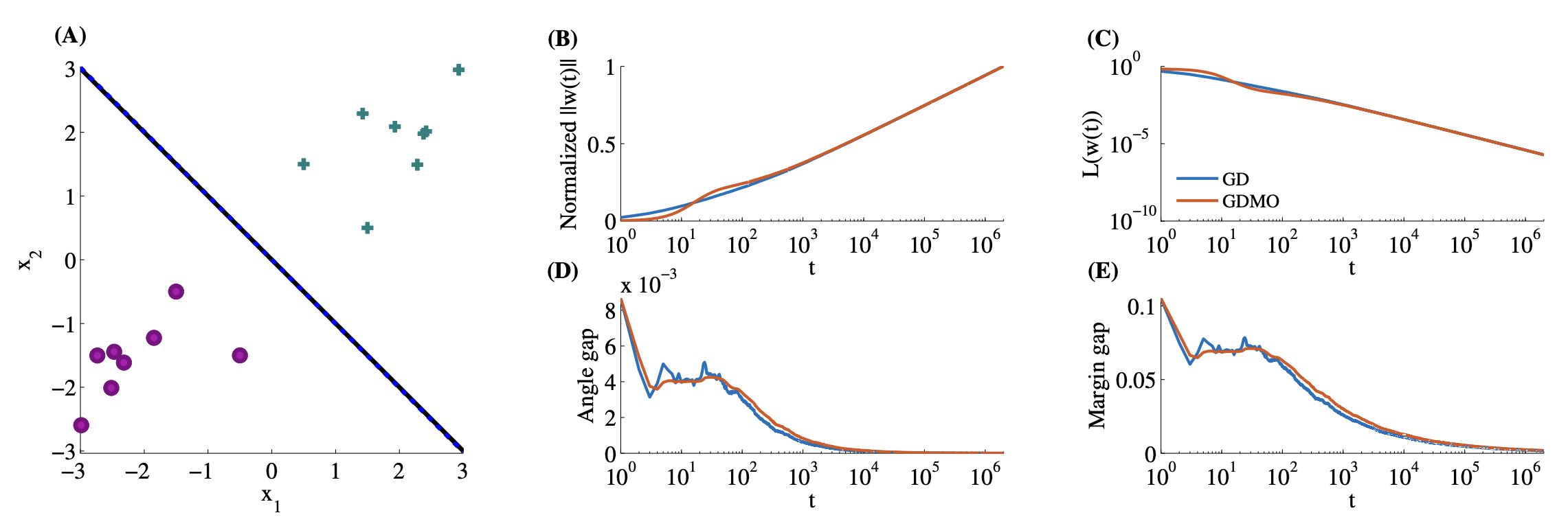
The clearest version of this story is not actually about neural networks. It is about logistic regression on linearly separable data. Once the classifier separates the data, the empirical classification error is already 0% and the logistic loss continues to decrease as the norm of the weights grows. There is no finite minimizer. What is more surprising is that the direction of the weights still converges. And it converges to the maximum-margin SVM solution.
The linear theorem
Let
In words: once the classifier has separated the data, gradient descent keeps reducing the logistic loss as long as the separation is preserved, except that unlike a traditional SVM it does so while continuing to grow the norm of the weights without bound. The norm grows only logarithmically with
A few things follow from the theorem. Gradient descent behaves as if it had been regularized toward the Euclidean max-margin classifier without anyone writing that regularizer down. It also explains why early stopping helps: because the weight norm diverges over time, stopping early caps the implicit penalty before the iterate gets too far. Ji and Telgarsky extended the result to the non-separable case, showing the iterate still tracks a unique ray defined by the data when no separating hyperplane exists. Nacson et al. [4] showed that aggressive learning-rate schedules accelerate convergence to the max-margin direction by polynomial factors over plain GD. The norm divergence itself is robust to dataset size and dimension: as long as the data is linearly separable, the iterate keeps moving away from the origin and never reaches a finite minimum.
The geometry enters
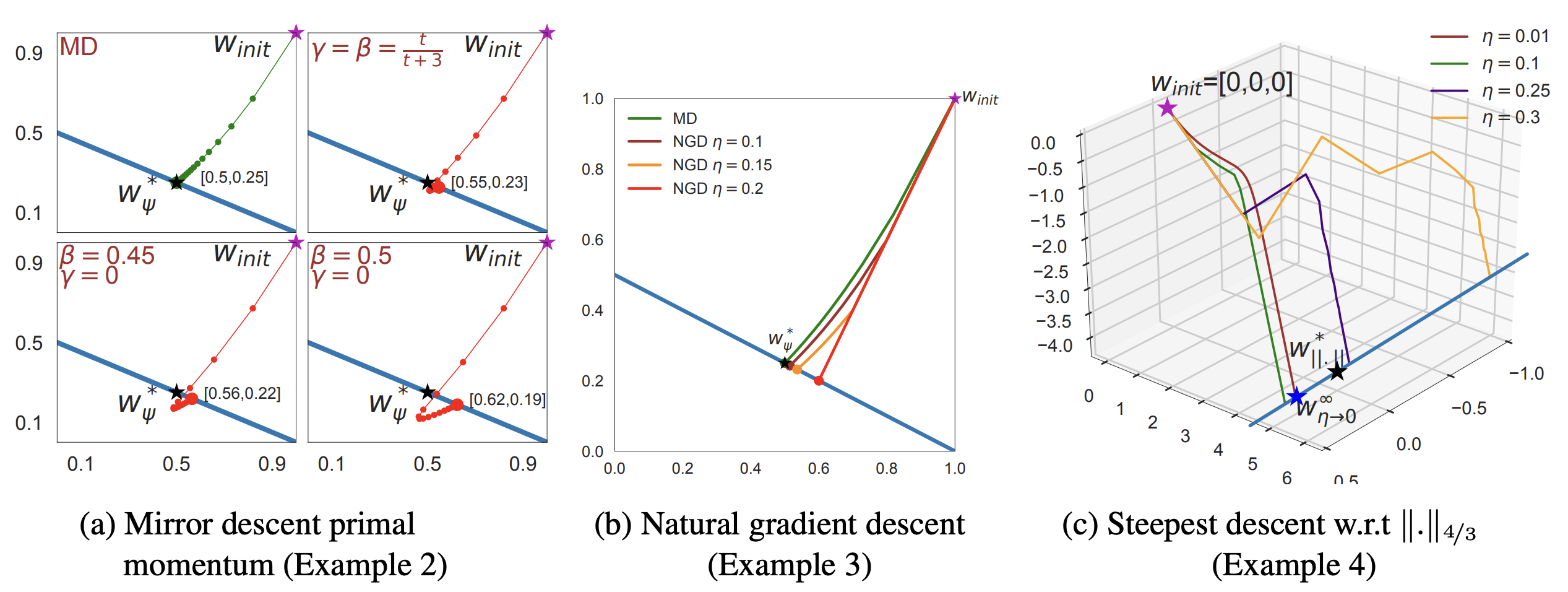
Gunasekar et al. [3] generalized the result: different optimization geometries select different implicit regularizers. Steepest descent under the
The linear-convolutional-network result is the cautionary case. For fully connected linear predictors, gradient descent picks out the familiar
Margin in homogeneous networks
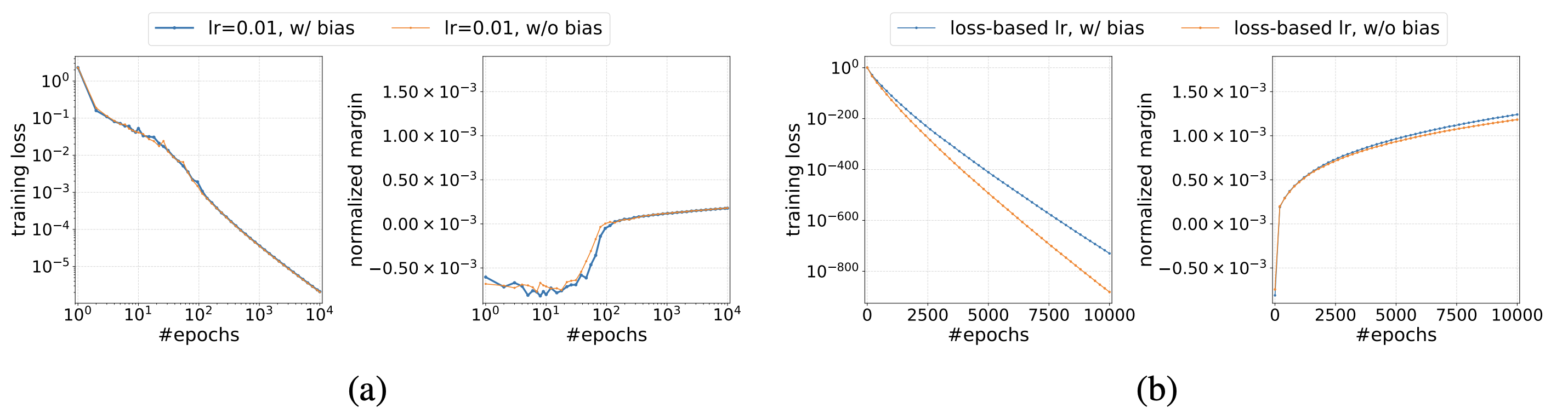
Lyu and Li push the result past linear predictors. If
Chizat and Bach prove a parallel mean-field result for two-layer networks with vanishing initializations. The implicit bias there is
It is widely thought that neural networks generalize because of implicit regularization of gradient descent. Today at #ICLR2023 we show new evidence to the contrary. We train with gradient-free optimizers and observe generalization competitive with SGD.openreview.net/forum?id=QC10RmRbZy9
Tom Goldstein @tomgoldsteincs,
My own reading is that the implicit-bias program is one of the few cases I can point to of a research direction being vindicated and outgrown at the same time. Soudry et al. [1] is true; the mechanism is real; the linear case is the only setting where I can prove anything I trust. What is unclear is whether the same phenomenon is the dominant explanation for why large feature-learning networks generalize, or whether at scale the data distribution and the architecture have already done so much of the work that the optimizer's preference is a small correction. I currently believe the second, but I do not have a falsifier I trust, which is exactly the position the field is in.
Further reading
- S. Gunasekar, J. Lee, D. Soudry, and N. Srebro. Implicit bias of gradient descent on linear convolutional networks. arxiv 1806.00468, 2018
- Z. Ji and M. Telgarsky. Risk and parameter convergence of logistic regression. arxiv 1803.07300, 2018
- K. Lyu and J. Li. Gradient descent maximizes the margin of homogeneous neural networks. arxiv 1906.05890, 2019
- L. Chizat and F. Bach. Implicit bias of gradient descent for wide two-layer neural networks trained with the logistic loss. arxiv 2002.04486, 2020
- S. Pesme, L. Pillaud-Vivien, and N. Flammarion. Implicit bias of SGD for diagonal linear networks: a provable benefit of stochasticity. arxiv 2106.09524, 2021
- E. Moroshko, S. Gunasekar, B. Woodworth, J. D. Lee, N. Srebro, and D. Soudry. Implicit bias in deep linear classification: initialization scale vs training accuracy. arxiv 2007.06738, 2020
References
- [1] D. Soudry, E. Hoffer, M. S. Nacson, S. Gunasekar, and N. Srebro. The implicit bias of gradient descent on separable data. arxiv 1710.10345, 2017.
- [2] C. Zhang, S. Bengio, M. Hardt, B. Recht, and O. Vinyals. Understanding deep learning requires rethinking generalization. arxiv 1611.03530, 2016.
- [3] S. Gunasekar, J. Lee, D. Soudry, and N. Srebro. Characterizing implicit bias in terms of optimization geometry. arxiv 1802.08246, 2018.
- [4] M. S. Nacson, J. Lee, S. Gunasekar, P. H. P. Savarese, N. Srebro, and D. Soudry. Convergence of gradient descent on separable data. arxiv 1803.01905, 2019.