The edge of stability
Cohen et al. [1] observed that gradient descent on neural networks spends most of training in a regime where the top Hessian eigenvalue
Progressive sharpening
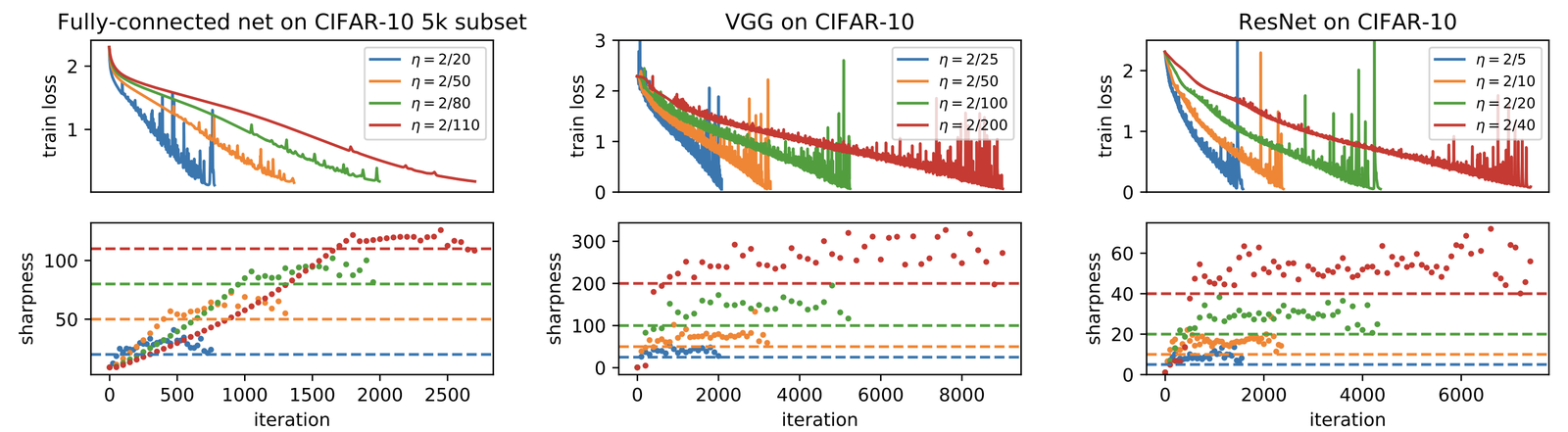
The first phase Cohen identified is progressive sharpening. From random initialization, gradient descent reliably drives the sharpness (
That direction is already counterintuitive. Classical optimization theory says you want to avoid sharp regions, since each step there costs more. Neural-network training does the opposite: it walks into sharper regions until the classical step size is no longer stable. Progressive sharpening itself is not well understood from first principles. Damian et al. [2] give a self-stabilization argument for what happens after the threshold is reached, and Ahn et al. [4] build on it, but neither predicts the sharpening from initialization. The observational picture is clean; the theoretical one is not.
Above the threshold
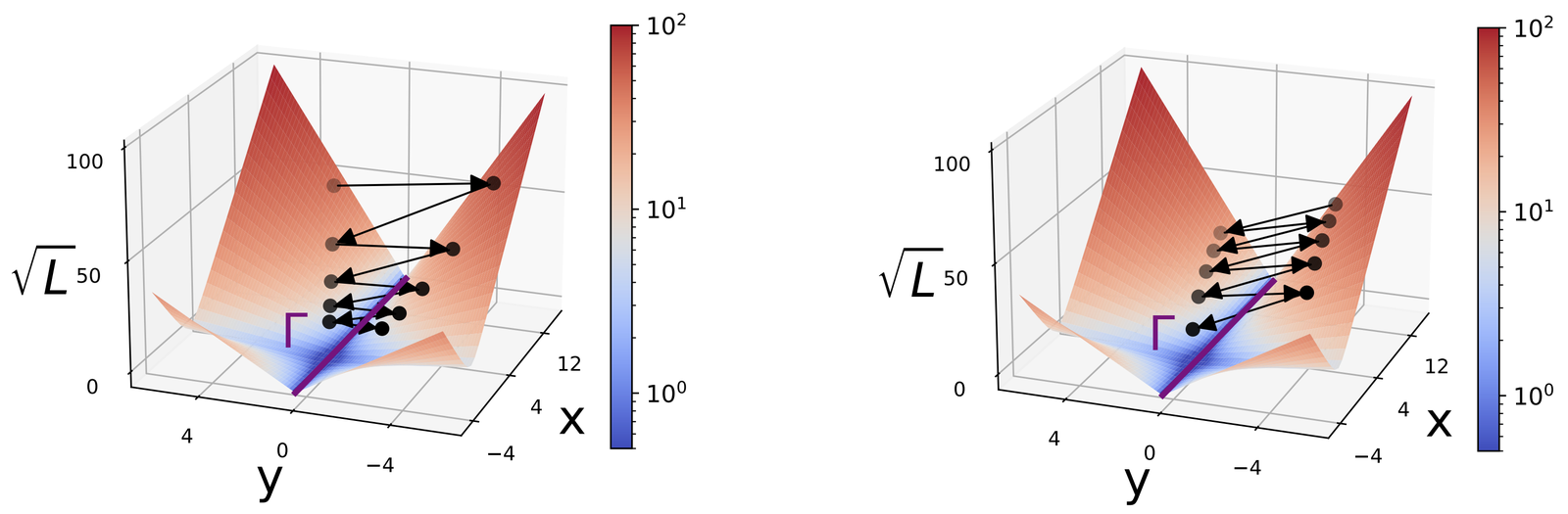
Once sharpness crosses
The mechanism is that the oscillation
And flat minima
The earlier flat-minima story started with Hochreiter and Schmidhuber and continued with Keskar et al. [7] and the later sharpness aware minimization literature. Broadly, the flat-minima story ran as follows: SGD with a small batch size produces gradient estimates with some noise
That noise looks like a random walk and tends to leave sharp minima more often than flat ones, so SGD ends up biased toward flat minima, and that bias was meant to be why neural networks generalize. Edge-of-stability does not contradict the story, but it reshapes it. The learning rate itself caps how sharp a reachable minimum can be: anything with

The reframing lives mostly outside the papers themselves. Off Convex has a few posts on implicit bias, trajectory analysis, and why the classical descent lemma is genuinely misleading for neural networks instead of merely approximate. Ben Recht's ArgMin is the complementary skeptical take for once you have left convex optimization theory
Andreyev and Beneventano (arxiv 2412.20553) extended the story to the mini-batch setting Cohen did not analyze, introducing an "edge of stochastic stability" where the quantity that pins at
A few previously folklore-level phenomena become intelligible from this picture. Warmup schedules
Both schedules had been used empirically for years before any principled account existed. Lewkowycz et al.'s catapult mechanism [5], where an initial loss spike sometimes precedes a better final solution, is the same dynamics at a larger scale: a large learning rate pushes the trajectory through a briefly very sharp region, the loss spikes, and the trajectory then settles into a different basin from the one it would have reached at a smaller step size.
The generalization gap is still open
Edge-of-stability gives a clean account of why SGD ends up in flat minima, but it says nothing about why flat minima generalize. Those are distinct questions, and the second one is still open.
Dinh et al. [6] showed that the Hessian-based notion of sharpness is not reparameterization invariant, so sharpness in that form cannot directly control generalization.
Even with full-batch gradients, DL optimizers defy classical optimization theory, as they operate at the *edge of stability.*
With @alex_damian_, we introduce "central flows": a theoretical tool to analyze these dynamics that makes accurate quantitative predictions on real NNs. the video in this tweet
Jeremy Cohen @deepcohen,
Further reading
- deep dive into the edge of stability
- J. Frankle, G. K. Dziugaite, D. M. Roy, and M. Carbin. Linear mode connectivity and the lottery ticket hypothesis. arxiv 1912.05671, 2019
- P. M. Long and P. L. Bartlett. Sharpness-aware minimization and the edge of stability. Journal of Machine Learning Research, 2024
- J. M. Cohen, A. Damian, A. Talwalkar, J. Z. Kolter, and J. D. Lee. Understanding optimization in deep learning with central flows. arxiv 2410.24206, 2024
- S. Hochreiter and J. Schmidhuber. Flat minima. Neural Computation, 9(1):1-42, 1997
References
- [1] J. M. Cohen, S. Kaur, Y. Li, J. Z. Kolter, and A. Talwalkar. Gradient descent on neural networks typically occurs at the edge of stability. arxiv 2103.00065, 2021.
- [2] A. Damian, E. Nichani, and J. D. Lee. Self-stabilization: The implicit bias of gradient descent at the edge of stability. arxiv 2209.15594, 2022.
- [3] S. Arora, Z. Li, and A. Panigrahi. Understanding gradient descent on edge of stability in deep learning. arxiv 2205.09745, 2022.
- [4] K. Ahn, J. Zhang, and S. Sra. Understanding the unstable convergence of gradient descent. arxiv 2204.01050, 2022.
- [5] A. Lewkowycz, Y. Bahri, E. Dyer, J. Sohl-Dickstein, and G. Gur-Ari. The large learning rate phase of deep learning: The catapult mechanism. arxiv 2003.02218, 2020.
- [6] L. Dinh, R. Pascanu, S. Bengio, and Y. Bengio. Sharp minima can generalize for deep nets. arxiv 1703.04933, 2017.
- [7] N. S. Keskar, D. Mudigere, J. Nocedal, M. Smelyanskiy, and P. T. P. Tang. On large-batch training for deep learning: generalization gap and sharp minima. arxiv 1609.04836, 2016.